How to Approach Hybrid Air and Land Surveillance Drone Assignments

Claim Your Offer
Unlock an amazing offer at www.programminghomeworkhelp.com with our latest promotion. Get an incredible 10% off on your all programming assignment, ensuring top-quality assistance at an affordable price. Our team of expert programmers is here to help you, making your academic journey smoother and more cost-effective. Don't miss this chance to improve your skills and save on your studies. Take advantage of our offer now and secure exceptional help for your programming assignments.
We Accept








- Understanding the Core Architecture of Hybrid Surveillance Drone Assignments
- Breaking Down the System Requirements
- Understanding Component Selection Logic
- Designing the Working Principle
- Developing the Technical Sections of Drone Surveillance Assignments
- Creating Effective Block Diagrams and System Flowcharts
- Explaining Hardware and Embedded Integration
- Solving Common Challenges in Air and Land Surveillance Drone Projects
- Managing Weight and Power Distribution
- Improving Surveillance and Communication Reliability
- Writing Strong Conclusions and Future Enhancements
- Why Students Seek Professional Programming and Electronics Assignment Help
Students working on electronics, embedded systems, robotics, IoT, and drone-based surveillance projects are increasingly being assigned hybrid mobility systems that combine aerial navigation with land movement capabilities. One common example is a 2WD vehicle drone air and land surveillance system that can operate both as a flying drone and as a ground vehicle for terrain monitoring, obstacle navigation, and remote surveillance operations. These assignments are not limited to theoretical concepts alone. They often involve hardware selection, embedded control logic, wireless communication, motor integration, surveillance systems, and practical design documentation. Many students struggle because such projects require multidisciplinary knowledge spanning drone mechanics, robotics, sensor integration, power systems, and wireless communication protocols. Due to these technical challenges, students frequently search online for services related to “do my programming assignment” when they face difficulties with coding, controller integration, or system implementation.
A major mistake students make in such assignments is treating the project like a generic drone system. Hybrid drone-vehicle projects involve different engineering challenges because the system must balance aerial stability with ground mobility. This affects motor selection, frame design, controller programming, and power distribution between aerial and terrestrial operations. That is why many students seek support from an embedded system assignment helper to better understand implementation logic, report structuring, and technical documentation standards expected in engineering coursework.
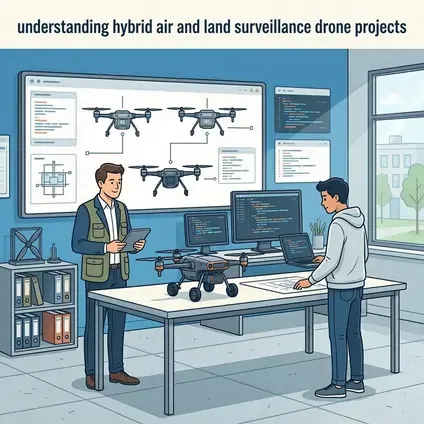
Understanding the Core Architecture of Hybrid Surveillance Drone Assignments
Assignments involving air and land surveillance drones generally revolve around designing a system capable of remote navigation, real-time monitoring, and dual-mode mobility. The project may include components such as brushless DC motors, drone controllers, RC transmitters, wireless cameras, BO motors, camera transmitters, receivers, and chassis integration.
The objective is usually to develop a surveillance platform that can patrol difficult environments where a normal drone or a standard land robot alone may fail. Since the drone can fly over barriers and drive under obstacles, the assignment often focuses on mobility optimization, surveillance efficiency, and system coordination.
Breaking Down the System Requirements
The first step in solving such assignments is requirement analysis. Students must identify exactly what the system is expected to perform. Requirements generally include:
- Aerial movement capability
- Ground navigation capability
- Wireless remote control
- Live surveillance video transmission
- Motor synchronization
- Lightweight but stable chassis design
- Power management
- Signal communication between transmitter and receiver
Many submissions lose marks because students directly start describing components without explaining why those components are necessary. Requirement analysis creates the engineering foundation of the report.
Understanding Component Selection Logic
One of the most technical sections is component selection. Students must explain not only what components are used but also why they are suitable.
For example, brushless DC motors are commonly selected for drone propulsion because they provide:
- High rotational speed
- Better efficiency
- Reduced friction losses
- Longer operational lifespan
- Improved power-to-weight ratio
Similarly, BO motors are often used for land mobility because they are lightweight and easy to integrate with compact robotic platforms.
A strong assignment should explain how each component contributes to overall system functionality. Instead of simply listing components, students should discuss:
- Voltage requirements
- Power consumption
- Torque requirements
- Weight limitations
- Communication compatibility
- Control efficiency
- Environmental adaptability
Students should also explain how the drone controller interacts with RC receivers and motor drivers to coordinate movement. Many assignments require block diagrams, wiring logic, and signal-flow explanations, so understanding interconnections becomes extremely important.
When discussing wireless cameras and surveillance modules, students should explain concepts such as:
- Real-time video transmission
- Signal latency
- Camera range
- Power usage
- Monitoring applications
Designing the Working Principle
The working principle section is one of the most heavily evaluated portions of hybrid drone assignments. This section should explain the operational sequence of the entire system.
An effective working principle explanation usually follows this order:
- User sends commands through RC transmitter
- Receiver module accepts directional instructions
- Flight controller processes the command
- Brushless motors adjust drone movement
- BO motors activate during land navigation
- Wireless camera transmits live footage
- Power system distributes energy to subsystems
Students should clearly explain mode switching between aerial and land operations. This is a critical feature in hybrid systems.
For example, when the drone encounters overhead obstacles or limited flight zones, the system may switch to wheel-based navigation. When terrain becomes difficult for wheel movement, the system may resume aerial operation.
Assignments that explain operational logic with clarity generally score better because they demonstrate actual understanding of embedded control systems.
Developing the Technical Sections of Drone Surveillance Assignments
Once the system architecture is understood, the next stage involves developing technical sections such as block diagrams, circuit explanations, control algorithms, and implementation strategies.
This is where students often face difficulties because hybrid surveillance systems combine multiple engineering domains simultaneously.
Creating Effective Block Diagrams and System Flowcharts
Block diagrams are extremely important in electronics and embedded system assignments because they visually represent system interaction.
A good hybrid surveillance drone block diagram should include:
- RC transmitter
- Receiver module
- Flight controller
- Brushless motors
- Motor drivers
- Wireless camera
- Video transmitter
- Battery unit
- BO motors
- Ground movement system
Students should avoid overly complicated diagrams with unnecessary wiring details. The purpose of a block diagram is to simplify system understanding.
Flowcharts are equally important because they explain operational logic. A basic surveillance drone flowchart may include:
- System initialization
- Signal reception
- Movement mode detection
- Flight control activation
- Ground navigation activation
- Camera surveillance operation
- Obstacle handling
- Shutdown process
Many students lose marks by downloading generic diagrams from the internet that do not match the actual project architecture. Custom diagrams aligned with the assignment topic always perform better academically.
When writing explanations below diagrams, students should discuss:
- Data flow
- Control signals
- Power distribution
- Communication channels
- Functional dependencies
This demonstrates technical understanding rather than superficial documentation.
Explaining Hardware and Embedded Integration
Assignments involving surveillance drones often require students to discuss hardware interfacing and embedded integration.
This section should explain how different modules communicate with each other.
For example:
- RC receiver communicates with drone controller
- Controller generates signals for motors
- Wireless camera transmits video data
- Battery powers all systems
- BO motors receive directional signals
Students should also discuss synchronization challenges.
In hybrid systems, simultaneous coordination between aerial propulsion and ground movement can create issues such as:
- Power imbalance
- Weight distribution problems
- Signal interference
- Motor timing delays
- Battery drainage
- Thermal issues
Assignments become stronger when students identify engineering limitations rather than pretending the system is perfect.
If programming is involved, students should explain control logic at a high level. For example:
- Input command acquisition
- Signal processing
- Directional control mapping
- PWM signal generation
- Motor activation sequences
- Emergency stop handling
Even if the assignment does not require complete source code, discussing embedded logic improves technical depth.
Students working on implementation-based projects may also include:
- Arduino integration
- Raspberry Pi surveillance modules
- IoT communication concepts
- GPS tracking logic
- Sensor integration
- Obstacle detection methods
However, all additions should remain relevant to the original project scope.
Solving Common Challenges in Air and Land Surveillance Drone Projects
Hybrid drone assignments are difficult because they involve multiple interconnected engineering challenges. Understanding these problems helps students create more realistic and technically sound reports.
Managing Weight and Power Distribution
One of the biggest engineering challenges in hybrid drone systems is balancing weight with performance. Unlike traditional drones, hybrid systems carry additional components such as:
- Wheels
- Ground motors
- Extra chassis supports
- Surveillance modules
- Camera transmitters
This increases the overall payload.
Students should explain how excess weight affects:
- Flight stability
- Battery backup
- Motor efficiency
- Lift generation
- Drone responsiveness
An effective assignment should discuss methods to reduce unnecessary structural load while maintaining overall system durability and performance. Students can explain how engineering trade-offs are involved when selecting lightweight materials versus high-strength components.
Some common optimization techniques include:
- Using carbon fiber or lightweight composite frames
- Reducing redundant wiring inside the chassis
- Choosing compact surveillance modules
- Integrating low-power communication systems
- Using balanced battery placement for improved center of gravity
Proper weight balancing also improves drone maneuverability during transitions between air mode and land mode. If the center of gravity shifts excessively toward one side, the drone may experience unstable lift, uneven landing, or inefficient wheel movement.
Students can strengthen their assignments further by discussing how engineers calculate payload limitations before integrating additional surveillance equipment. Explaining the relationship between payload capacity and thrust generation demonstrates deeper understanding of drone mechanics and embedded mobility systems.
Another important consideration is thermal management. Additional motors and electronic systems increase heat generation during continuous operation. Assignments can discuss the use of heat sinks, airflow management, and efficient power distribution techniques to prevent overheating.
Including these engineering discussions transforms the report from a basic descriptive document into a technically analytical assignment that reflects real-world drone design considerations. to reduce weight while maintaining structural strength.
Possible approaches include:
- Lightweight drone frames
- Compact motor integration
- Efficient battery placement
- Reduced wiring complexity
- Optimized component arrangement
Battery management is another important area. Since the drone powers both aerial and land systems, energy consumption becomes critical. Students should discuss how flight operations consume significantly more power than wheel-based navigation.
Assignments that analyze power trade-offs demonstrate advanced engineering understanding.
Improving Surveillance and Communication Reliability
The surveillance section should not be treated as a simple camera attachment. Surveillance systems are central to these assignments.
Students should explain how video transmission works between the onboard camera and remote receiver.
Key discussion points may include:
- Wireless transmission range
- Real-time monitoring
- Signal stability
- Interference issues
- Camera positioning
- Latency management
In advanced assignments, students can also discuss:
- Infrared surveillance
- Night vision systems
- Motion detection
- GPS-enabled tracking
- Live streaming architecture
Communication reliability is equally important. RC-controlled systems depend heavily on stable communication links. Students should discuss what happens if signal interruption occurs.
Potential solutions may include:
- Signal redundancy
- Auto-landing logic
- Emergency shutdown systems
- Return-to-home mechanisms
- Frequency stabilization
Including these considerations makes the project report appear practical and professionally engineered.
Writing Strong Conclusions and Future Enhancements
Many students weaken their assignments by writing short, generic conclusions. A strong conclusion should summarize:
- System objectives
- Major functionalities
- Engineering benefits
- Technical limitations
- Real-world applications
Applications for hybrid surveillance drone projects include:
- Border patrolling
- Disaster monitoring
- Rough terrain inspection
- Industrial surveillance
- Agricultural monitoring
- Military reconnaissance
The future scope section is equally important. Students can discuss improvements such as:
- AI-based obstacle detection
- Autonomous navigation
- Machine learning surveillance analytics
- Solar-powered charging systems
- Enhanced terrain mobility
- Long-range communication systems
- Advanced stabilization algorithms
Teachers often appreciate assignments that show awareness of industry trends and future technological possibilities.
Why Students Seek Professional Programming and Electronics Assignment Help
Projects involving hybrid surveillance drones are highly interdisciplinary. Students are expected to combine electronics, embedded systems, communication engineering, robotics, and technical documentation into one assignment.
This creates several academic challenges.
First, many students understand theory but struggle with implementation logic. They may know what a drone controller or brushless motor does but fail to explain how the components interact within the complete system.
Second, assignments often require technical documentation standards that students are unfamiliar with. Institutions expect:
- Structured reports
- Proper block diagrams
- System architecture explanations
- Working principles
- Component justifications
- Implementation flowcharts
- Application analysis
- Future enhancement discussions
Without proper guidance, students frequently produce reports that are either too theoretical or too superficial.
Another challenge is multidisciplinary integration. A hybrid air-and-land surveillance system is not purely an electronics project. It involves:
- Embedded programming
- Power electronics
- Robotics logic
- Wireless communication
- Mechanical balancing
- Surveillance integration
Students who are comfortable in one domain may struggle in another. Time constraints also become a major issue.
Time constraints also become a major issue. Building diagrams, researching components, understanding communication protocols, and writing technical explanations require significant effort. Many students attempt to complete everything close to the submission deadline, which reduces assignment quality.
Professional programming and electronics assignment help services assist students by simplifying complex project workflows and improving technical presentation. Instead of providing copied content, effective academic guidance focuses on helping students understand:
- How hybrid systems operate
- How components interact
- How to explain implementation logic
- How to structure technical reports
- How to create diagrams and documentation
- How to discuss limitations and future scope
Assignments related to drone surveillance systems require clarity, engineering reasoning, and system-level thinking. The strongest submissions are those that explain not only what the system does but also how and why it works.
As drone technology, robotics, and autonomous surveillance systems continue evolving, academic projects in this area are becoming more advanced and industry-oriented.
Students who learn how to approach these assignments systematically gain stronger analytical, documentation, and technical problem-solving skills that are valuable far beyond the classroom.
Whether the assignment focuses on aerial surveillance, land mobility, wireless monitoring, embedded control, or hybrid robotic navigation, success depends on understanding the project as an integrated engineering system rather than isolated hardware components.
That approach leads to stronger reports, better implementation logic, and higher academic performance.