Create a Program to Implement Buffer Overflows in C++ Assignment Solution
.svg)
- Instructions
- Requirements and Specifications
Instructions
Objective
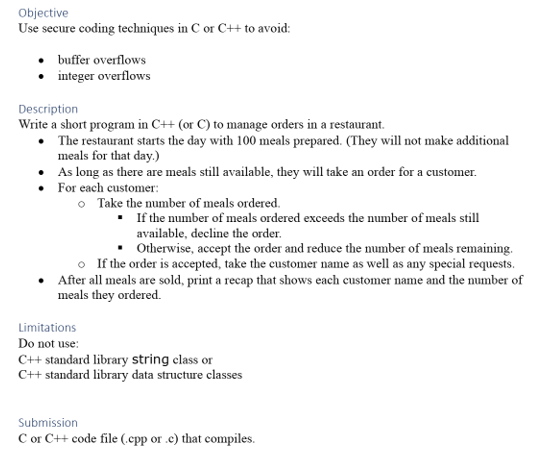
Write a C++ assignment program to implement buffer overflows.
Requirements and Specifications
Source Code
#include

#include

using namespace std;

const int MAX_MEAL = 100;

const int MAX_NAME_LEN = 20;

// Holds a customer data and the next customer after it (Linked list)

struct Customer

{

 char name[MAX_NAME_LEN];

 int numOrders;

 Customer *next;

 // Initialize a customer

 Customer()

 {

 numOrders = 0;

 next = NULL;

 }

};

// Make sure to read a positive int that doesn't overflow

// Since this is a simple application, we shouldn't retrieve an input

// that is more than 100 or below 0. This we we protect the app

// from under or overflow

int readNumOrders()

{

 while (1)

 {

 cout << "Enter the number of meals to order for next customer: ";

 int value;

 // Make sure it's within bounds. When the user enters a very very very

 // large number, it will overflow and it will wrap around but we only

 // accept values that is within 1 to 100 to make the app still work

 // as expected

 if (cin >> value)

 {

 cin.clear();

 cin.ignore();

 if (value >= 1 && value <= MAX_MEAL)

 return value;

 }

 else

 {

 cin.clear();

 cin.ignore();

 }

 cout << "Invalid value." << endl;

 }

}

// Read a name making sure that the number of characters is within the buffer

// bounds. If an overflow is to happen, we will reject all other incoming characters

void readName(char *name)

{

 cout << "Enter customer's name: ";

 int i;

 bool overflowed = true;

 for (i = 0; i < MAX_NAME_LEN - 1; i++)

 {

 char c = fgetc(stdin);

 if (c == '\n')

 {

 overflowed = false;

 break;

 }

 name[i] = c;

 }

 name[i] = '\0';

 if (overflowed)

 {

 // Delete all other incoming characters until we get the new line

 char c;

 while ((c = fgetc(stdin)) != '\n');

 }

 }

// Entry point of the program

int main()

{

 Customer *lastCustomer = NULL;

 // Start with 100 meals prepared

 int mealsLeft = MAX_MEAL;

 // As long as there are meals still available, hey will take an order for a

 // customer

 while (mealsLeft > 0)

 {

 cout << "There are " << mealsLeft << " orders left..." << endl;

 Customer *customer = new Customer();

 customer->numOrders = readNumOrders();

 readName(customer->name);

 if (customer->numOrders <= 0 || customer->numOrders > mealsLeft)

 {

 // If the number of meals ordered exceeds the number of meals still

 // available, decline the order.

 cout << "Invalid number of orders." << endl;

 delete customer;

 }

 else

 {

 // Otherwise, accept the order and reduce the number of meals remaining.

 mealsLeft -= customer->numOrders;

 customer->next = lastCustomer;

 lastCustomer = customer;

 }

 }

 // After all meals are sold, print a recap that shows each customer name and the number of

 // meals they ordered.

 cout << endl;

 cout << "Orders from latest to oldest:" << endl;

 while (lastCustomer != NULL)

 {

 cout << lastCustomer->name << ": " << lastCustomer->numOrders << endl;

 Customer *nextCustomer = lastCustomer->next;

 delete lastCustomer;

 lastCustomer = nextCustomer;

 }

 return 0;

}
Related Samples
Explore our C++ programming homework samples to see how we tackle complex assignments with clarity and precision. Our curated examples demonstrate expertise in algorithms, data structures, object-oriented concepts, and more. Trust ProgrammingHomeworkHelp.com for top-notch solutions tailored to your academic needs.
C++
C++
C++
C++
C++
C++
C++
C++
C++
C++
C++
C++
C++
C++
C++
C++
C++
C++
C++
C++