.png)
Instructions
Objective
Writing a program to implement sets in C++ can be a valuable learning experience. Sets are containers that store unique elements in no particular order, making them useful for various applications. By utilizing the standard template library (STL) in C++, you can easily create and manipulate sets. If you need help with your C++ assignment focused on set implementation or any related concepts, feel free to ask for guidance and clarification.
Requirements and Specifications
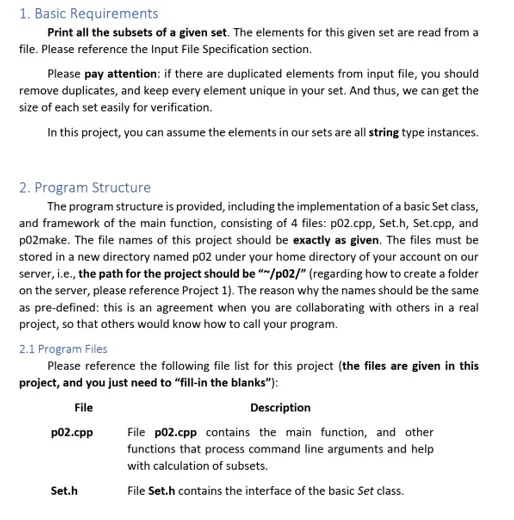
Source Code
#include
	#include
	#include
	#include
	#include
	#include "Set.h"
	#include
	#ifndef MAX_FILE_LENGTH
	#define MAX_FILE_LENGTH 255
	#endif // MAX_FILE_LENGTH
	using namespace std;
	/**
	* Read the input set from the input stream, and output the subsets
	* to the output stream.
	*/
	void get_subsets(istream& i1, ostream& o)
	{
	Set set1;
	set1.scan(i1); // read the set from the input file
	set1.print(o, "A="); // print the set to the output file
	/* Please put your code here. */
	o << "Subsets of A:" << std::endl;
	// Loop from 0 to 2^n-1 where n is the size of the set
	int n = set1.getsize();
	int n_subsets = pow(2, n);
	for(int i = 0; i < n_subsets; i++) {
	o << "{";
	for(int j = 0; j < n; j++) {
	if(i & (1 << j)) { // binary operator
	o << set1.getelements()[j];
	if(j < n-1) {
	o << ",";
	}
	}
	}
	o << "}";
	if(i < n_subsets-1) {
	o << ",";
	}
	else {
	o << ".";
	}
	o << std::endl;
	}
	// Finally, write the number of subsets
	o << "There are " << pow(2, set1.getsize()) << " subsets of A.";
	// TODO: get all the subsets of the input set and print the result
	}
	/*
	* This program accepts three command line arguments:
	* argv[1] is for the path to input file
	* argv[2] is for the path to the output file
	*/
	int main(int argc, char* argv[])
	{
	char file1[MAX_FILE_LENGTH], file2[MAX_FILE_LENGTH];
	// file1 is for the input, file2 is for the output
	strcpy(file1, argv[1]);
	strcpy(file2, argv[2]);
	ifstream i1 (file1);
	ofstream o (file2);
	if (i1.is_open() && o.is_open()) {
	get_subsets(i1, o);
	i1.close();
	o.close();
	}
	else {
	cout << "Unable to open the file(s)." << endl;
	}
	}
Related Samples
Explore our comprehensive Data Structures and Algorithms assignment samples to enhance your understanding. These expertly crafted examples cover a wide range of topics, offering clear explanations and practical solutions to complex problems. Perfect for students aiming to excel in their coursework.
C++
C++
C++
C++
C++
C++
C++
C++
C++
C++
C++
C++
C++
C++
C++
C++
C++
C++
C++
C++