Create a Program to Implement Temperature Statistics in C++ Assignment Solution

- Instructions
- Requirements and Specifications
Instructions
Objective
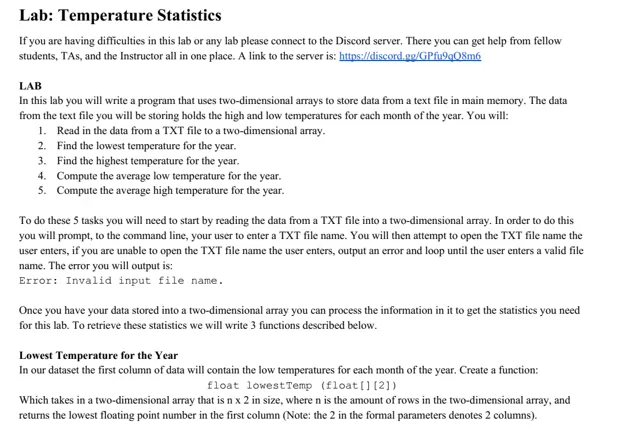
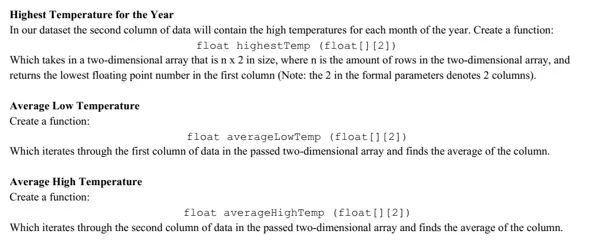
Write a c++ assignment program to implement temperature statistics.
Requirements and Specifications
Source Code
#include
	#include
	#include
	#include
	#include
	#include
	using namespace std;
	// Function prototypes
	float lowestTemp(float temperatures[][2]);
	float highestTemp(float temperatures[][2]);
	float averageLowTemp(float temperatures[][2]);
	float averageHighTemp(float temperatures[][2]);
	// Entry point of the program
	int main()
	{
	cout << "TEMPERATURE STATISTICS" << endl;
	// Open file for reading and loading of temperature
	ifstream inFile;
	while (true)
	{
	cout << "What is the data file name?" << endl;
	cout << "**";
	string filename;
	getline(cin, filename);
	inFile.open(filename.c_str());
	if (inFile.is_open())
	break;
	cout << "Error: Invalid input file name." << endl;
	}
	cout << endl;
	// Read the title
	string line;
	getline(inFile, line);
	cout << line << endl;
	cout << endl;
	// Load the temperatures into an array, 12 months
	float temperatures[12][2];
	for (int i = 0; i < 12; i++)
	{
	getline(inFile, line);
	stringstream ss(line);
	ss >> temperatures[i][0];
	ss >> temperatures[i][1];
	}
	inFile.close();
	// Report statistics
	char degreeSign = '\370';
	cout << "Lowest temperature of the year was " << lowestTemp(temperatures) << degreeSign << " F." << endl;
	cout << "Highest temperature of the year was " << highestTemp(temperatures) << degreeSign << " F." << endl;
	cout << "Average low temperature of the year was " << averageLowTemp(temperatures) << degreeSign << " F." << endl;
	cout << "Average high temperature of the year was " << averageHighTemp(temperatures) << degreeSign << " F." << endl;
	return 0;
	}
	// Find the lowest temperature
	float lowestTemp(float temperatures[][2])
	{
	float lowest = 0;
	for (int i = 0; i < 12; i++)
	if (i == 0 || temperatures[i][0] < lowest)
	lowest = temperatures[i][0];
	// Round to 2 decimal places
	lowest = ceil(lowest * 100.0f) / 100.0f;
	return lowest;
	}
	// Find the highest temperature
	float highestTemp(float temperatures[][2])
	{
	float highest = 0;
	for (int i = 0; i < 12; i++)
	if (i == 0 || temperatures[i][1] > highest)
	highest = temperatures[i][1];
	// Round to 2 decimal places
	highest = ceil(highest * 100.0f) / 100.0f;
	return highest;
	}
	// Return the average low temperature
	float averageLowTemp(float temperatures[][2])
	{
	float total = 0;
	for (int i = 0; i < 12; i++)
	total += temperatures[i][0];
	float average = total / 12;
	// Round to 2 decimal places
	average = ceil(average * 100.0f) / 100.0f;
	return average;
	}
	// Return the average high temperature
	float averageHighTemp(float temperatures[][2])
	{
	float total = 0;
	for (int i = 0; i < 12; i++)
	total += temperatures[i][1];
	float average = total / 12;
	// Round to 2 decimal places
	average = ceil(average * 100.0f) / 100.0f;
	return average;
	}
Related Samples
Explore our free C++ assignment samples to gain a clear perspective on programming concepts. These samples provide detailed solutions and practical examples, showcasing various C++ applications and techniques. Whether you're working on basic syntax or complex algorithms, our samples offer valuable insights and clarity, making it easier to approach your C++ assignments with confidence.
C++
C++
C++
C++
C++
C++
C++
C++
C++
C++
C++
C++
C++
C++
C++
C++
C++
C++
C++
C++