Add Lambda Expressions In Haskell Assignment Solution
-(3).webp)
- Instructions
- Objective
- Requirements and Specifications
Instructions
Objective
Write a program to add lambda add lambda expressions in haskel..
Requirements and Specifications
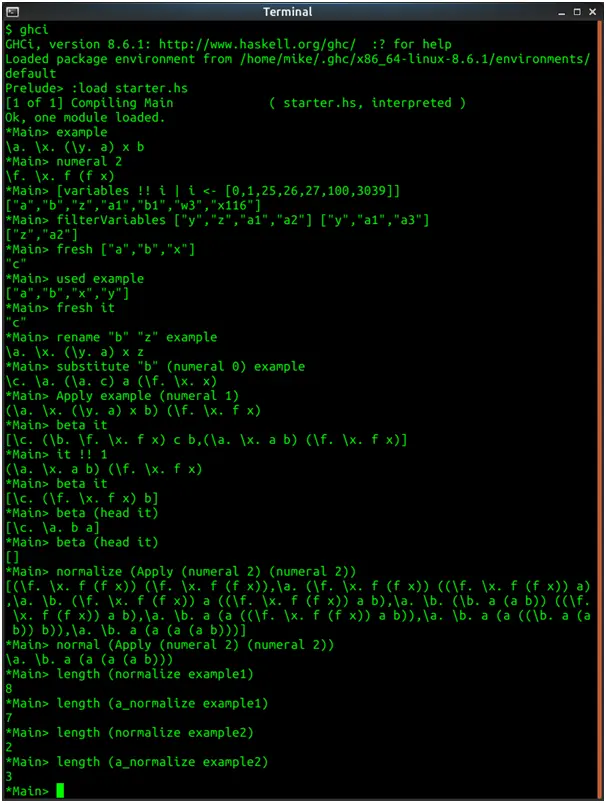
Screenshots of output
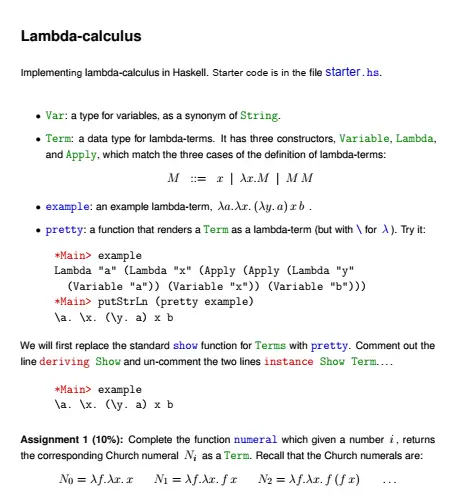
Source Code
type Var = String
data Term =
    Variable Var
  | Lambda   Var  Term
  | Apply    Term Term
--  deriving Show
instance Show Term where
  show = pretty
example :: Term
example = Lambda "a" (Lambda "x" (Apply (Apply (Lambda "y" (Variable "a")) (Variable "x")) (Variable "b")))
pretty :: Term -> String
pretty = f 0
    where
      f i (Variable x) = x
      f i (Lambda x m) = if i /= 0 then "(" ++ s ++ ")" else s where s = "\\" ++ x ++ ". " ++ f 0 m
      f i (Apply  n m) = if i == 2 then "(" ++ s ++ ")" else s where s = f 1 n ++ " " ++ f 2 m
------------------------- Assignment 1
numeral :: Int -> Term
numeral i = Lambda "f" (Lambda "x" (ni i "x" "f"))
    where
        ni 0 x _ = Variable x
        ni n x f = Apply (Variable f) (ni (n - 1) x f)
-------------------------
merge :: Ord a => [a] -> [a] -> [a]
merge xs [] = xs
merge [] ys = ys
merge (x:xs) (y:ys)
    | x == y    = x : merge xs ys
    | x <= y    = x : merge xs (y:ys)
    | otherwise = y : merge (x:xs) ys
------------------------- Assignment 2
variables :: [Var]
variables = [[c] | c <- ['a'..'z']] ++ [[c]++(show i) |i <- [1..], c <- ['a'..'z']]
filterVariables :: [Var] -> [Var] -> [Var]
filterVariables xs ys = filter (\x -> not (elem x ys)) xs
fresh :: [Var] -> Var
fresh xs = head (filterVariables variables xs)
used :: Term -> [Var]
used (Variable v) = [v]
used (Lambda v t) = merge [v] (used t)
used (Apply x y) = merge (used x) (used y)
------------------------- Assignment 3
rename :: Var -> Var -> Term -> Term
rename x y (Variable z) = Variable (if z == x then y else z)
rename x y l@(Lambda z n) = if z == x then l else Lambda z (rename x y n)
rename x y (Apply  n m) = Apply (rename x y n) (rename x y m)
substitute :: Var -> Term -> Term -> Term
substitute x n (Variable y) = if y == x then n else Variable y
substitute x n l@(Lambda y m) = if y == x then l else Lambda z (substitute x n ((rename y z) m))
    where
        z = fresh ((used m) ++ (used n) ++ [x])
substitute x n (Apply m1 m2) = Apply (substitute x n m1) (substitute x n m2)
------------------------- Assignment 4
beta :: Term -> [Term]
beta (Apply l@(Lambda x n) m) = [substitute x m n] ++ (map (\x -> (Apply x m)) (beta l)) ++ (map (\y -> (Apply l y)) (beta m))
beta (Variable _) = []
beta (Lambda x n1) = map (\y-> Lambda x y) (beta n1)
beta (Apply n m) = (map (\x -> (Apply x m)) (beta n)) ++ (map (\y -> (Apply n y)) (beta m))
normalize :: Term -> [Term]
normalize t = t : (eval_beta t)
    where
        eval_beta a = case beta a of
            [] -> []
            (x:xs) -> x : (eval_beta x)
normal :: Term -> Term
normal t = last (normalize t)
-------------------------
a_beta :: Term -> [Term]
a_beta (Apply l@(Lambda x n) m) = (map (\x -> (Apply x m)) (a_beta l)) ++ (map (\y -> (Apply l y)) (a_beta m)) ++ [substitute x m n]
a_beta (Variable _) = []
a_beta (Lambda x n1) = map (\y-> Lambda x y) (a_beta n1)
a_beta (Apply n m) = (map (\x -> (Apply x m)) (a_beta n)) ++ (map (\y -> (Apply n y)) (a_beta m))
a_normalize :: Term -> [Term]
a_normalize t = t : (eval_beta t)
    where
        eval_beta a = case a_beta a of
            [] -> []
            (x:xs) -> x : (eval_beta x)
a_normal :: Term -> Term
a_normal t = last (a_normalize t)
-------------------------
example1 :: Term
example1 = Apply (Apply (numeral 2) (numeral 2)) (Variable "s")
example2 :: Term
example2 = Apply (Lambda "p" (Lambda "q" (Variable "q"))) (Apply (Lambda "a" (Variable "b")) (Lambda "c" (Variable "d")))
Similar Samples
Discover our curated selection of programming assignment samples at ProgrammingHomeworkHelp.com. Our samples cover a wide array of languages and topics, showcasing our expertise in delivering accurate and timely solutions. Whether you need help with Java, Python, SQL, or more specialized tasks, explore our samples to see how we can assist you in mastering programming challenges.
Haskell
Haskell
Haskell
Haskell
Haskell
Haskell
Haskell
Haskell
Haskell
Haskell
Haskell
Haskell
Haskell
Haskell
Haskell
Haskell
Haskell
Haskell
Haskell
Haskell