Program to Implement Convolution Network in Python Assignment Solution

- Instructions
- Requirements and Specifications
Instructions
Objective
Write a program to implement convolution network in python.
Requirements and Specifications
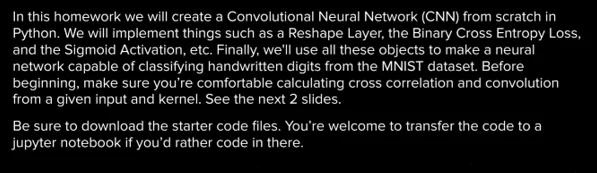
Source Code
ACTIVISION
import numpy as np

from layer import Layer

class Activation(Layer):

 def __init__(self, activation, activation_prime):

 self.activation = activation

 self.activation_prime = activation_prime

 def forward(self, input):

 self.input = input

 return self.activation(self.input)

 def backward(self, output_gradient, learning_rate):

 return np.multiply(output_gradient, self.activation_prime(self.input))
CONVOLUTION
import numpy as np

from scipy import signal

from layer import Layer

class Convolutional(Layer):

 def __init__(self, input_shape, kernel_size, depth):

 input_depth, input_height, input_width = input_shape

 self.depth = depth

 self.input_shape = input_shape

 self.input_depth = input_depth

 self.output_shape = (depth, input_height - kernel_size + 1, input_width - kernel_size + 1)

 self.kernels_shape = (depth, input_depth, kernel_size, kernel_size)

 self.kernels = np.random.randn(*self.kernels_shape)

 self.biases = np.random.randn(*self.output_shape)

 def forward(self, input):

 self.input = input

 self.output = np.copy(self.biases)

 # TODO: Implement the forward method using the formula provided in the powerpoint.

 # You may add or remove any variables that you wish.

 for i in range(self.depth):

 for j in range(self.input_depth):

 self.output[i] += signal.correlate2d(self.input[j], self.kernels[i, j], "valid")

 return self.output

 def backward(self, output_gradient, learning_rate):

 # TODO: initialize the kernels_gradient and input_gradient.

 kernels_gradient = np.zeros(self.kernels_shape)

 input_gradient = np.zeros(self.input_shape)

 # TODO: implement the back pass here. The equations in the ppt may help, but you're free to

 # add as much or as little code as you'd like.

 for i in range(self.depth):

 for j in range(self.input_depth):

 kernels_gradient[i, j] = signal.correlate2d(self.input[j], output_gradient[i], "valid")

 input_gradient[j] += signal.convolve2d(output_gradient[i], self.kernels[i, j], "full")

 # TODO: update the kernels and biases

 self.kernels -= learning_rate * kernels_gradient

 self.biases -= learning_rate * output_gradient

 return input_gradient
DENSE
import numpy as np

from layer import Layer

class Dense(Layer):

 def __init__(self, input_size, output_size):

 self.weights = np.random.randn(output_size, input_size)

 self.bias = np.random.randn(output_size, 1)

 def forward(self, input):

 # TODO: apply linear transformation to the input. see ppt for equation.

 self.input = input

 self.output = (np.dot(self.weights,input) + self.bias)

 return self.output

 def backward(self, output_gradient, learning_rate):

 # TODO: update the weights and bias

 weights_gradient = np.dot(output_gradient,self.input.T)

 X_gradient = np.dot(self.weights.T,output_gradient)

 self.weights -= learning_rate * weights_gradient

 self.bias -= learning_rate * output_gradient

 return X_gradient
Similar Samples
Explore our expertly crafted programming solutions at ProgrammingHomeworkHelp.com. From Java to Python, our samples showcase top-notch code snippets and comprehensive explanations, perfect for enhancing your programming skills and understanding.
Python
Python
Python
Python
Python
Python
Python
Python
Python
Python
Python
Python
Python
Python
Python
Python
Python
Python
Python
Python