Create A Program to Implement Greeting Function in Python Assignment Solution
.webp)
- Instructions
- Requirements and Specifications
Instructions
Requirements and Specifications
Source Code
# your name
# EA_3
# CHAPTER 6
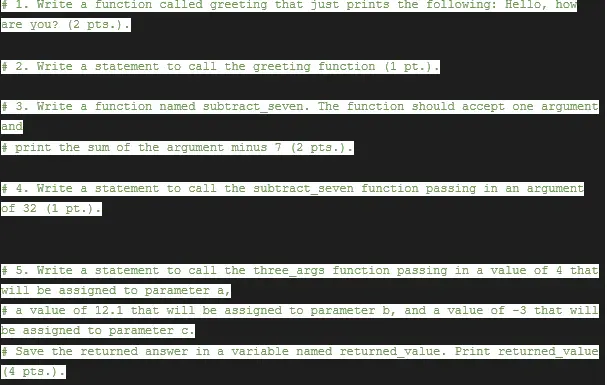
# 1. Write a function called greeting that just prints the following: Hello, how are you? (2 pts.).
def greeting():
print("Hello, how are you?")
# 2. Write a statement to call the greeting function (1 pt.).
greeting()
# 3. Write a function named subtract_seven. The function should accept one argument and
# print the sum of the argument minus 7 (2 pts.).
def subtract_seven(x):
# Print the number x minust 7
print(x-7)
# 4. Write a statement to call the subtract_seven function passing in an argument of 32 (1 pt.).
subtract_seven(32)
# 5. Write a statement to call the three_args function passing in a value of 4 that will be assigned to parameter a,
# a value of 12.1 that will be assigned to parameter b, and a value of -3 that will be assigned to parameter c.
# Save the returned answer in a variable named returned_value. Print returned_value (4 pts.).
def three_args(a, b, c): # DO NOT DELETE OR UPDATE THIS FUNCTION
answer = a + b * c # DO NOT DELETE OR UPDATE THIS FUNCTION
return answer # DO NOT DELETE OR UPDATE THIS FUNCTION
# Call function
returned_value = three_args(4, 12.1, -3)
print(returned_value)
Related Samples
Visit our Python Assignments Sample Section to explore exemplary solutions crafted by our experts. From fundamental Python scripts to intricate data analysis projects, these samples demonstrate our expertise in delivering top-notch programming solutions. Gain insights and inspiration for your assignments now!
Python
Python
Python
Python
Python
Python
Python
Python
Python
Python
Python
Python
Python
Python
Python
Python
Python
Python
Python
Python